Income Tax Slab FY 2026-27: New vs Old Regime Rates, Zero Tax Up to ₹12.75 Lakh & 6 Easy Examples

The income tax slab FY 2026-27 is the same as last year. Budget 2026 did not change the tax rates, so the new tax regime still offers zero tax on income up to ₹12 lakh, or up to ₹12.75 lakh for salaried employees after the ₹75,000 standard deduction. The big change this year is the law itself: the new Income-tax Act, 2025 came into force on 1 April 2026, replacing the Income-tax Act, 1961, and introducing the simpler concept of a “tax year”.
If you are planning your investments, declaring your regime to your employer, or estimating your tax for the year, this guide is for you. We explain the income tax slab FY 2026-27 under both regimes, the rebate and deductions, six easy examples, and how to choose the right regime.
Table of Contents
New Tax Regime: Income Tax Slab FY 2026-27
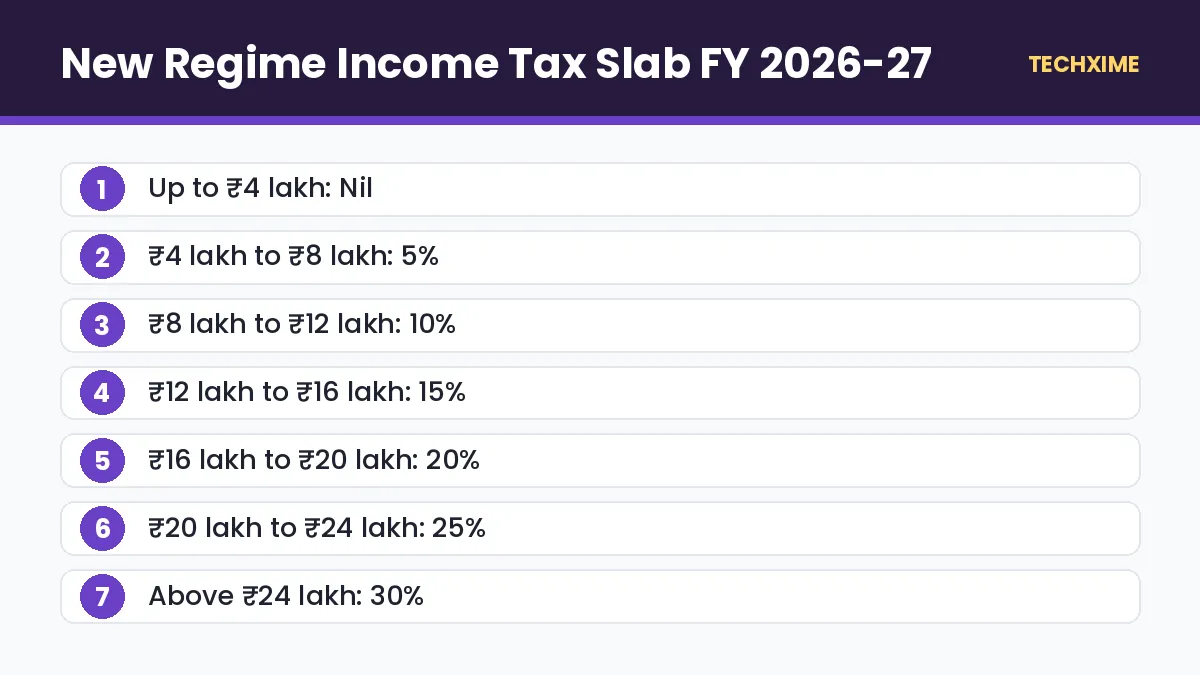
The new tax regime is the default regime. Unless you choose the old regime, your employer will deduct TDS under these rates.
| Income Range | Tax Rate |
|---|---|
| Up to ₹4,00,000 | Nil |
| ₹4,00,001 to ₹8,00,000 | 5% |
| ₹8,00,001 to ₹12,00,000 | 10% |
| ₹12,00,001 to ₹16,00,000 | 15% |
| ₹16,00,001 to ₹20,00,000 | 20% |
| ₹20,00,001 to ₹24,00,000 | 25% |
| Above ₹24,00,000 | 30% |
Health and education cess of 4% applies on the tax amount. Surcharge applies for very high incomes.
Rebate: Zero Tax Up to ₹12 Lakh
Resident individuals with taxable income up to ₹12 lakh under the new regime get a rebate of up to ₹60,000, which makes their tax zero. Budget 2026 clarified that this rebate does not apply to special-rate income such as capital gains on equity or lottery winnings.
Standard Deduction: ₹75,000
Salaried employees and pensioners get a standard deduction of ₹75,000 under the new regime. That is why salaried people pay zero tax on salary up to ₹12.75 lakh.
Marginal Relief Above ₹12 Lakh
If your taxable income is slightly above ₹12 lakh, marginal relief ensures that your tax does not exceed the amount by which your income exceeds ₹12 lakh. This prevents a sudden jump in tax for a small increase in income.
Old Tax Regime: Income Tax Slab FY 2026-27
The old regime allows many deductions and exemptions, such as Section 80C, 80D, HRA and home loan interest, but has higher rates.
| Income Range | Below 60 Years | 60 to 79 Years | 80 Years and Above |
|---|---|---|---|
| Up to ₹2,50,000 | Nil | Nil | Nil |
| ₹2,50,001 to ₹3,00,000 | 5% | Nil | Nil |
| ₹3,00,001 to ₹5,00,000 | 5% | 5% | Nil |
| ₹5,00,001 to ₹10,00,000 | 20% | 20% | 20% |
| Above ₹10,00,000 | 30% | 30% | 30% |
Under the old regime, the rebate makes tax zero for taxable income up to ₹5 lakh, and the standard deduction for salaried employees is ₹50,000.
6 Easy Examples Under the New Regime
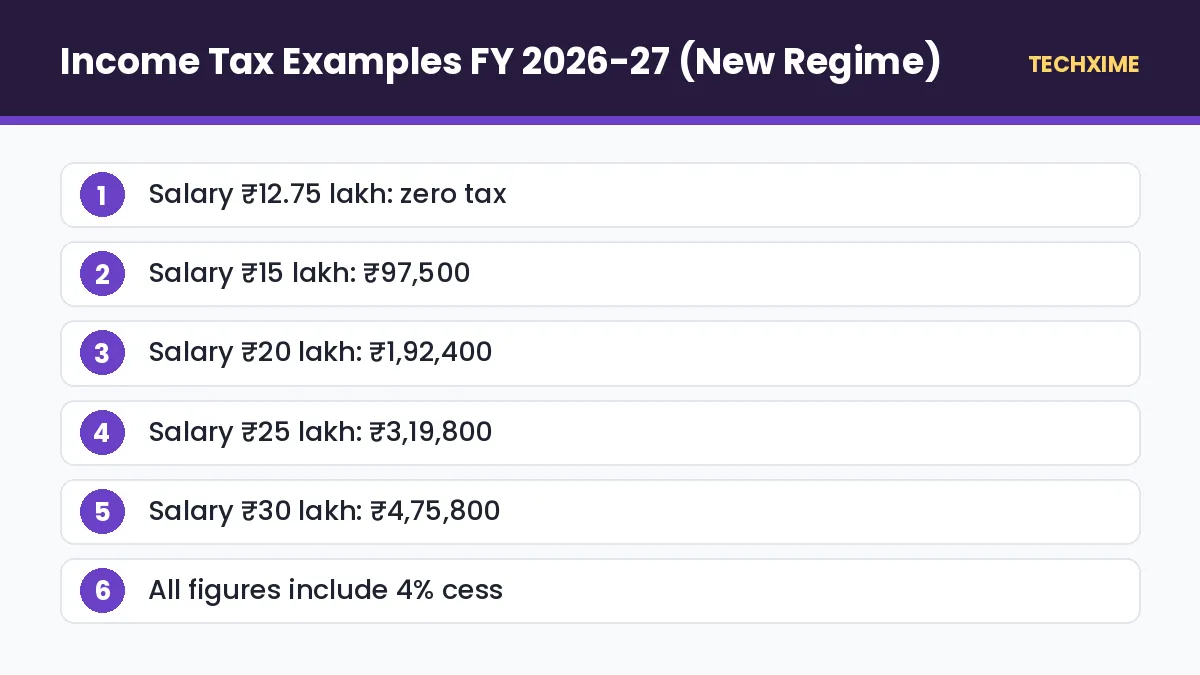
Here is how the income tax slab FY 2026-27 works for salaried employees under the new regime. Figures include 4% cess and assume no other income.
| Gross Salary | Taxable Income (after ₹75,000) | Tax Payable |
|---|---|---|
| ₹8,00,000 | ₹7,25,000 | Nil (rebate) |
| ₹12,75,000 | ₹12,00,000 | Nil (rebate) |
| ₹15,00,000 | ₹14,25,000 | ₹97,500 |
| ₹20,00,000 | ₹19,25,000 | ₹1,92,400 |
| ₹25,00,000 | ₹24,25,000 | ₹3,19,800 |
| ₹30,00,000 | ₹29,25,000 | ₹4,75,800 |
How the ₹15 Lakh Example Is Calculated
1. Gross salary: ₹15,00,000. 2. Less standard deduction: ₹75,000. Taxable income: ₹14,25,000. 3. Tax on ₹4–8 lakh at 5%: ₹20,000. 4. Tax on ₹8–12 lakh at 10%: ₹40,000. 5. Tax on ₹12–14.25 lakh at 15%: ₹33,750. 6. Total tax: ₹93,750. Add 4% cess: ₹3,750. Final tax: ₹97,500.
New Regime vs Old Regime: Which Is Better?
The new regime is better for most people because of the lower rates and the large rebate. The old regime can still be better if you claim large deductions.
| Point | New Regime | Old Regime |
|---|---|---|
| Tax-free income (salaried) | Up to ₹12.75 lakh | Up to about ₹5.5 lakh without other deductions |
| Standard deduction | ₹75,000 | ₹50,000 |
| Section 80C, 80D | Not allowed | Allowed |
| HRA, LTA | Not allowed | Allowed |
| Home loan interest (self-occupied) | Not allowed | Up to ₹2 lakh |
| Employer NPS contribution | Allowed | Allowed |
| Default regime | Yes | Must opt in |
When the Old Regime May Be Better
The old regime may save tax if your total deductions are very high, for example a combination of ₹1.5 lakh under 80C, health insurance under 80D, a large HRA exemption and ₹2 lakh of home loan interest. Use the income tax department’s calculator or ask a tax professional to compare both regimes with your actual numbers.
Old Regime Example
A salaried person earning ₹10 lakh who claims ₹1.5 lakh under 80C and the ₹50,000 standard deduction has taxable income of ₹8 lakh. Tax is ₹12,500 on ₹2.5–5 lakh plus ₹60,000 on ₹5–8 lakh, totalling ₹72,500, plus cess of ₹2,900, which equals ₹75,400. Under the new regime, the same person would pay zero tax because their taxable income is below ₹12 lakh.
What Changed With the Income-tax Act, 2025?
From 1 April 2026, India’s tax law is the Income-tax Act, 2025. Key changes for individuals include:
- Tax year: The confusing “previous year” and “assessment year” terms are replaced by a single “tax year”. FY 2026-27 is tax year 2026-27.
- Simpler language: Sections are renumbered and rewritten in plain language.
- Same rates: The income tax slab FY 2026-27 remains the same as last year.
- New ITR forms: Simplified forms are being notified for returns under the new Act.
Returns for income earned up to 31 March 2026 are still filed under the old Act, which is why you will see both systems for some time. To track your refund for last year, see our guide on ITR refund status.
Other Budget 2026 Changes for Taxpayers
– Higher STT on derivatives: Securities Transaction Tax on futures rose from 0.02% to 0.05%, and on options premium from 0.10% to 0.15%. – Share buybacks: Now taxed as capital gains for shareholders. – Sovereign Gold Bonds: Tax exemption on maturity applies only to original subscribers who hold until maturity. – TCS: Several TCS rates were reduced, including on overseas tour packages and education or medical remittances. – Revised returns: More time to file revised returns, with a nominal fee for late revisions.
How to Choose Your Regime at Work
At the start of the year, your employer asks which regime you want for TDS. If you do not choose, TDS is deducted under the new regime. Salaried individuals can usually switch regimes when filing their return each year. People with business income have fewer chances to switch, so they should decide carefully.
Tax-Saving Tips for FY 2026-27
– Ask your employer about NPS contributions under Section 80CCD(2) equivalent, which is allowed in both regimes. – Keep proofs of rent, insurance and investments if you choose the old regime. – Plan capital gains carefully; they are taxed at special rates and do not get the rebate. – Check your Annual Information Statement regularly. – Link your PAN and Aadhaar to avoid higher TDS. Check your PAN Aadhaar link status.
Quick Summary: Income Tax Slab FY 2026-27
– The income tax slab FY 2026-27 is unchanged from last year. – New regime: zero tax up to ₹12 lakh, or ₹12.75 lakh for salaried employees. – Old regime: higher rates but deductions like 80C, 80D, HRA and home loan interest. – The Income-tax Act, 2025 applies from 1 April 2026 and introduces the “tax year”. – Compare both regimes with your actual numbers before deciding.
Key Terms Explained
– Tax year: The 12-month period from April to March under the new Act. – Rebate: A reduction in tax for income up to a specified limit. – Standard deduction: A flat deduction for salaried employees and pensioners. – Cess: A 4% health and education levy on tax. – Marginal relief: Protection against a sudden jump in tax just above a threshold.
Expert Tips
– Run a quick comparison every April before declaring your regime to your employer. – Do not invest only to save tax; choose investments that fit your goals. – Keep your bank and PAN details updated on the e-filing portal for faster refunds. – Use the official calculator on the Income Tax e-filing portal to check your numbers.
Income Tax Slab FY 2026-27 for Senior Citizens
Under the new regime, there are no separate slabs for senior citizens; the same income tax slab FY 2026-27 applies to everyone. Under the old regime, senior citizens aged 60 to 79 get a basic exemption of ₹3 lakh, and super senior citizens aged 80 and above get ₹5 lakh.
Senior citizens also have other benefits under the old regime, such as a higher deduction for interest on deposits and health insurance premiums. Many pensioners still find the new regime better because of the ₹12 lakh rebate, but those with large medical expenses and interest income should compare both.
Income Tax Slab FY 2026-27: Surcharge Rates
High-income taxpayers pay a surcharge on top of tax.
| Taxable Income | New Regime Surcharge | Old Regime Surcharge |
|---|---|---|
| ₹50 lakh to ₹1 crore | 10% | 10% |
| ₹1 crore to ₹2 crore | 15% | 15% |
| ₹2 crore to ₹5 crore | 25% | 25% |
| Above ₹5 crore | 25% (capped) | 37% |
Marginal relief applies at each surcharge threshold.
Common Mistakes When Using the Income Tax Slab FY 2026-27
– Ignoring the standard deduction: Salaried employees should subtract ₹75,000 before applying the new regime slabs. – Applying the rebate to capital gains: The rebate does not cover special-rate income such as equity gains. – Forgetting cess: Always add 4% cess to the calculated tax. – Assuming the old regime is better: For most people, the new income tax slab FY 2026-27 under the new regime results in lower tax. – Mixing up years: Income for April 2026 to March 2027 is tax year 2026-27 under the new Act.
Quick Calculator: Estimate Your Tax in 4 Steps
1. Add up your total income for the year. 2. Subtract the standard deduction if you are salaried (₹75,000 in the new regime). 3. Apply the income tax slab FY 2026-27 rates to each portion of income. 4. Subtract any rebate and add 4% cess.
Income Tax Slab FY 2026-27: Final Checklist
1. Note that the income tax slab FY 2026-27 is unchanged from last year. 2. Calculate tax under both regimes using your real numbers. 3. Declare your preferred regime to your employer. 4. Keep proofs ready if you choose the old regime. 5. Review the income tax slab FY 2026-27 again before filing your return.
Frequently Asked Questions
What is the income tax slab FY 2026-27 under the new regime?
Nil up to ₹4 lakh, 5% from ₹4–8 lakh, 10% from ₹8–12 lakh, 15% from ₹12–16 lakh, 20% from ₹16–20 lakh, 25% from ₹20–24 lakh and 30% above ₹24 lakh.
Did Budget 2026 change tax slabs?
No. The slabs and rates remain the same as the previous year.
Is income up to ₹12 lakh tax-free?
Yes, under the new regime, resident individuals with taxable income up to ₹12 lakh pay zero tax due to the rebate. Salaried employees get zero tax up to ₹12.75 lakh.
Which regime should I choose?
The new regime suits most people. The old regime may be better if your total deductions and exemptions are very high.
What is a tax year?
Under the Income-tax Act, 2025, the tax year replaces the earlier previous year and assessment year terms.
Does the rebate apply to capital gains?
No. The rebate does not apply to special-rate income such as equity capital gains.
Conclusion
The income tax slab FY 2026-27 remains unchanged, so the new regime continues to offer zero tax up to ₹12 lakh, or ₹12.75 lakh for salaried employees. What has changed is the legal framework, with the Income-tax Act, 2025 introducing the simpler “tax year”. Compare both regimes using your real income and deductions, declare your choice to your employer, and plan your investments early so that tax time is stress-free.