

8th Pay Commission Latest Update: Fitment Factor, Salary Hike, Report Date & 10 Key Facts (October 2026)

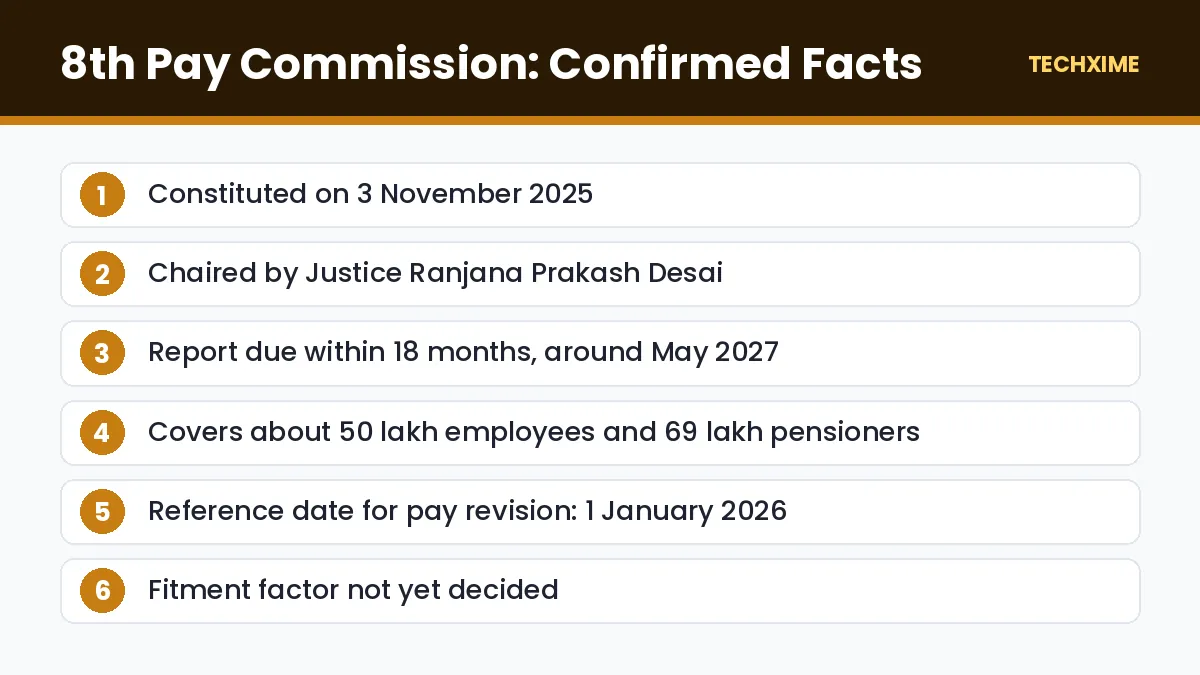
The 8th Pay Commission is now in its consultation stage, holding meetings with employee groups and state governments across India in October 2026. The commission was formally constituted on 3 November 2025 under the chairpersonship of Justice Ranjana Prakash Desai, and its report is due within 18 months, which means by around May 2027. Its recommendations will decide the new salaries of about 50 lakh central government employees and pensions of about 69 lakh pensioners.
Every week brings new claims on social media about the fitment factor, minimum salary and arrears. Some are informed estimates, and many are pure guesswork. In this guide, we separate confirmed facts from expectations, explain how the fitment factor works, show salary examples at different fitment levels, and answer the most common questions about the 8th Pay Commission.

Table of Contents
8th Pay Commission: What Is Confirmed So Far
Here are the facts that have been officially confirmed by the government.
| Detail | Status |
|---|---|
| Terms of Reference approved | 28 October 2025 |
| Commission formally constituted | 3 November 2025 |
| Chairperson | Justice Ranjana Prakash Desai |
| Part-time member | Prof. Pulak Ghosh |
| Member-Secretary | Pankaj Jain |
| Time to submit report | 18 months from constitution |
| Expected report | Around May 2027 |
| Reference date for revision | 1 January 2026 |
| Beneficiaries | About 50 lakh employees and 69 lakh pensioners |
8th Pay Commission Latest Update: October 2026
In October 2026, the commission is meeting stakeholders in different states to collect views on pay, allowances and pensions. Meetings are scheduled in cities such as Bengaluru (7 and 8 October) and Mumbai later in the month. Employee federations, pensioner associations and state governments are presenting memoranda with their demands.
This consultation stage is important because the commission’s recommendations will be based on these inputs, along with economic data, the government’s fiscal position and comparisons with private sector pay.
What Is the Fitment Factor?
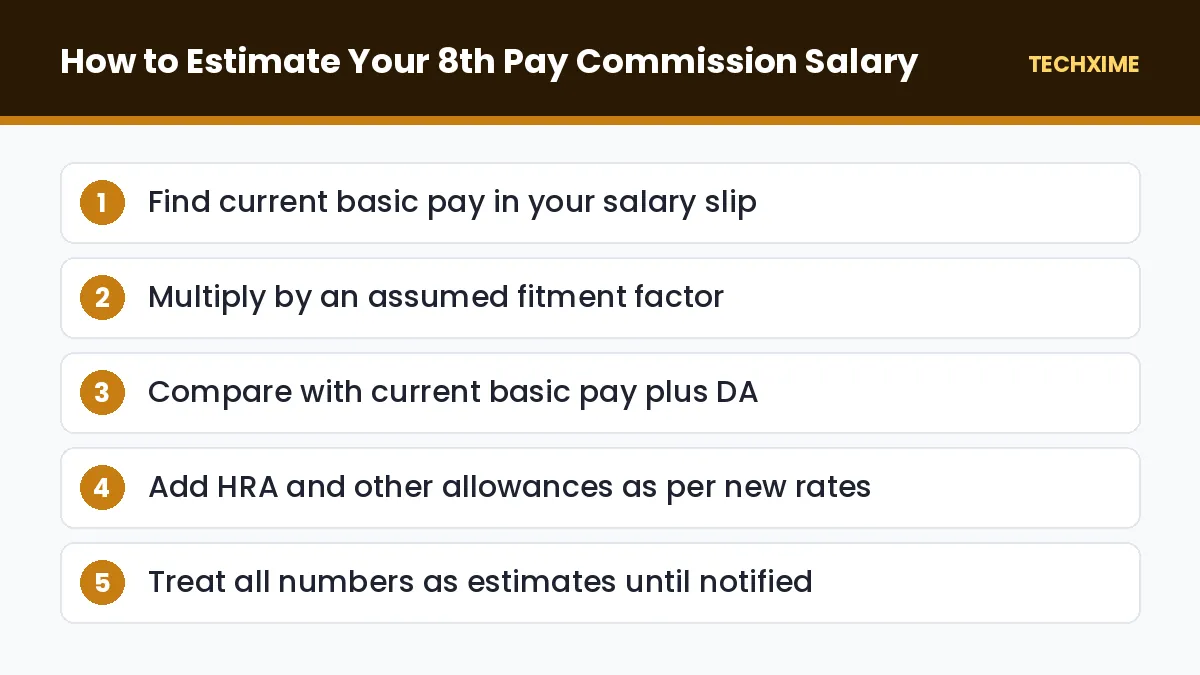
The fitment factor is the multiplier used to convert your current basic pay into the new basic pay. It is the single most important number in the 8th Pay Commission.
New basic pay = Current basic pay × Fitment factor
Under the 7th Pay Commission, the fitment factor was 2.57. That raised the minimum basic pay from ₹7,000 to ₹18,000.
What Fitment Factor Can Employees Expect?
The 8th Pay Commission has not announced any fitment factor yet. Estimates in media reports range from about 1.9 to above 2.8. Employee unions are demanding a higher factor, while economists point out that a large multiplier puts heavy pressure on government finances.
One important point: by January 2026, DA had already reached 60% of basic pay. Since accumulated DA is usually merged into basic pay when a new pay commission is implemented, a fitment factor of at least 1.60 would only keep salaries roughly where they are today. Any real increase comes from the portion above that.
Salary Examples Under Different Fitment Factors
The table below shows how the 8th Pay Commission could change basic pay at different fitment factors. These are illustrations only, not official figures.
| Current Basic Pay | Factor 1.92 | Factor 2.28 | Factor 2.57 | Factor 2.86 |
|---|---|---|---|---|
| ₹18,000 | ₹34,560 | ₹41,040 | ₹46,260 | ₹51,480 |
| ₹25,500 | ₹48,960 | ₹58,140 | ₹65,535 | ₹72,930 |
| ₹35,400 | ₹67,968 | ₹80,712 | ₹90,978 | ₹1,01,244 |
| ₹44,900 | ₹86,208 | ₹1,02,372 | ₹1,15,393 | ₹1,28,414 |
| ₹56,100 | ₹1,07,712 | ₹1,27,908 | ₹1,44,177 | ₹1,60,446 |
Remember that DA restarts at zero after a new pay commission, so compare the new basic pay with your current basic pay plus DA, not just your basic pay.
8th Pay Commission and Pensioners
Pensioners will also benefit from the 8th Pay Commission. Their basic pension is expected to be revised using the same fitment factor, and Dearness Relief will restart from zero on the revised pension. The minimum pension under the 7th Pay Commission is ₹9,000 per month, and pensioner associations are asking for a significant increase.
The Terms of Reference also ask the commission to consider the financial sustainability of pension liabilities, including the National Pension System (NPS) and the Unified Pension Scheme (UPS).
When Will the 8th Pay Commission Be Implemented?
The commission must submit its report within 18 months, which means around May 2027. After that:
- The government studies the recommendations.
- The Union Cabinet approves them, sometimes with changes.
- The Department of Expenditure issues notifications.
- Revised salaries and pensions are paid, usually with arrears.
Under the 7th Pay Commission, the report was submitted in November 2015, and implementation was approved in June 2016 with effect from 1 January 2016. A similar gap could mean that 8th Pay Commission salaries are paid sometime in late 2027 or 2028.
Will Employees Get Arrears From January 2026?
The government has used 1 January 2026 as the reference date. If the recommendations are implemented with effect from that date, employees and pensioners could receive arrears for the period between January 2026 and the actual implementation. However, the effective date and arrears will be decided only when the government accepts the report. Treat any arrears figures you see online as estimates.
What Happens to DA Until Then?
DA will continue under the 7th Pay Commission formula until the new pay structure is implemented. DA reached 60% from January 2026, and the DA hike for July 2026 is expected to take it to 63%. Read our detailed guide on the DA hike July 2026 for salary examples and arrears.
Key Demands From Employee Unions
Employee and pensioner organisations have submitted several demands to the 8th Pay Commission. Common demands include:
- A higher fitment factor, often 2.8 or above.
- A higher minimum basic pay than ₹18,000.
- Revision of allowances such as HRA, travel and children’s education allowance.
- Restoration of the Old Pension Scheme or improvements to NPS and UPS.
- Faster pay revisions, possibly every five years instead of ten.
- Better medical facilities for pensioners.
These are demands, not decisions. The commission will weigh them against fiscal limits.
10 Key Facts About the 8th Pay Commission
1. It was constituted on 3 November 2025. 2. Justice Ranjana Prakash Desai is the chairperson. 3. The report is due within 18 months. 4. The reference date for pay revision is 1 January 2026. 5. About 50 lakh employees and 69 lakh pensioners will benefit. 6. The fitment factor has not been decided. 7. DA continues under the 7th Pay Commission until implementation. 8. Accumulated DA is expected to be merged into basic pay on implementation. 9. Pension sustainability, including NPS and UPS, is part of its mandate. 10. State governments usually adopt central recommendations later, with their own changes.
How the 8th Pay Commission Affects State Employees
The 8th Pay Commission applies only to central government employees and pensioners. However, many states set up their own pay commissions or adopt central recommendations with modifications. In practice, state employees often see their pay revised a year or two after the central implementation. Kerala, for example, follows its own pay revision cycle.
Beware of Fake News
For authentic news, check the official 8th Central Pay Commission website and Cabinet decisions on the Press Information Bureau website. These sources publish meeting schedules, consultation notices and official announcements about the 8th Pay Commission.
Because the 8th Pay Commission affects crores of families, misinformation spreads fast. Be careful about:
- Messages claiming a “final fitment factor” before the report is submitted.
- Fake “8th Pay Commission salary calculator” apps that ask for personal details.
- Videos promising immediate salary hikes or bonus payments.
Always rely on the official commission website, PIB releases and Department of Expenditure notifications.
Quick Summary: 8th Pay Commission
– The 8th Pay Commission was constituted in November 2025 and is now consulting stakeholders. – Its report is expected around May 2027. – The fitment factor is not decided; estimates range from about 1.9 to 2.8 or more. – 1 January 2026 is the reference date, but arrears depend on the government’s final decision. – DA continues under the current formula until the new pay structure is implemented.
Key Terms Explained
– Fitment factor: The multiplier used to calculate new basic pay from old basic pay. – Terms of Reference (ToR): The official list of issues the commission must study. – Pay matrix: A table of pay levels and increments for each grade. – DA merger: Adding accumulated DA into basic pay when a new structure starts. – UPS: Unified Pension Scheme, an assured pension option for central employees under NPS.
Expert Tips
– Keep a copy of your current pay slip to compare once the new pay matrix is notified. – Do not take loans or make big commitments based on unconfirmed salary estimates. – Follow your department’s notices and recognised union updates. – Plan for tax: higher pay and arrears will increase your taxable income. – Use our PF balance guide and other finance guides to plan savings.
How Previous Pay Commissions Changed Salaries
Looking at past commissions helps set realistic expectations for the 8th Pay Commission.
| Pay Commission | Implemented From | Fitment Factor | Minimum Basic Pay |
|---|---|---|---|
| 5th | 1 January 1996 | About 3.2 (varied) | ₹2,550 |
| 6th | 1 January 2006 | About 1.86 | ₹7,000 (with grade pay) |
| 7th | 1 January 2016 | 2.57 | ₹18,000 |
| 8th | Reference date 1 January 2026 | Not decided | Not decided |
Each commission has taken about two to three years from formation to payout. The 8th Pay Commission is following a similar path, with consultations in 2026 and a report expected in 2027.
What Should Employees Do Now?
– Stay informed: Follow official updates from the commission and the Department of Expenditure. – Submit views through associations: Recognised employee and pensioner associations are presenting memoranda to the commission. – Plan finances conservatively: Base your budget on your current salary and DA. – Keep records: Save salary slips from 2026 onwards to verify any arrears later.
Frequently Asked Questions
What is the latest update on the 8th Pay Commission?
In October 2026, the 8th Pay Commission is holding consultation meetings with stakeholders in different states. Its report is due around May 2027.
Who is the chairperson of the 8th Pay Commission?
Justice Ranjana Prakash Desai is the chairperson.
What will be the fitment factor?
It has not been decided. Media estimates range from about 1.9 to above 2.8.
When will the 8th Pay Commission be implemented?
After the report is submitted around May 2027, the government will decide on implementation. Payouts may begin in late 2027 or later.
Will there be arrears from January 2026?
1 January 2026 is the reference date. Whether arrears are paid from that date depends on the government’s final decision.
Does the 8th Pay Commission apply to state employees?
No. It applies to central government employees and pensioners. States decide separately.
Conclusion
The 8th Pay Commission is moving steadily through its consultation stage, with its report expected around May 2027. While the final fitment factor and salary structure are still unknown, the confirmed facts are clear: the reference date is 1 January 2026, about 1.19 crore employees and pensioners will benefit, and DA will continue as usual until the new pay matrix arrives. Follow official updates, use estimates only as a rough guide, and plan your finances carefully until the final recommendations are announced.