New SIM Card Rules 2026: 9-SIM Limit Explained & 7 Easy Steps to Check SIMs in Your Name

The new SIM card rules that came into force from August 24, 2026 make it much harder to get more mobile connections than the law allows. Telecom operators such as Jio, Airtel, Vi and BSNL now have to check how many connections you already hold across all networks before issuing a new SIM. The limit is nine connections per person in most of India, and six in Jammu and Kashmir, Assam and the North-Eastern states.
These changes are aimed at stopping SIM-based fraud, fake accounts and cyber scams. If you have old or unused numbers in your name, or if someone misused your ID to get a SIM, you should act now. This guide explains the new SIM card rules in simple language and shows you exactly how to check every mobile number registered in your name in seven easy steps.
Table of Contents
What Are the New SIM Card Rules?
The limit of nine connections per person is not new. It has existed under Department of Telecommunications (DoT) guidelines for years and is now backed by the Telecommunications Act, 2023. What has changed is enforcement.
Earlier, each operator could only see its own customers. A person could hold nine SIMs with one operator and more with another. Under the new SIM card rules, operators must use a central system to see your total connections across all networks.
Here are the key changes in simple terms:
- Cross-operator check: Before issuing a new SIM, the operator checks your total connections across Jio, Airtel, Vi and BSNL.
- Refusal at the limit: If you have already reached the limit, the operator must refuse a new connection and inform you.
- Disclosure required: You may need to declare your existing numbers when applying for a new SIM.
- Photo-based matching: A facial image-based identification feature, active from August 23, 2026, helps detect people who use different documents to cross the limit.
- Clean-up of excess connections: People holding more SIMs than allowed may have to surrender, transfer or disconnect the extra numbers.
SIM Limit Under the New SIM Card Rules
| Region | Maximum Connections Per Person |
|---|---|
| Most of India | 9 |
| Jammu and Kashmir | 6 |
| Assam | 6 |
| North-Eastern states | 6 |
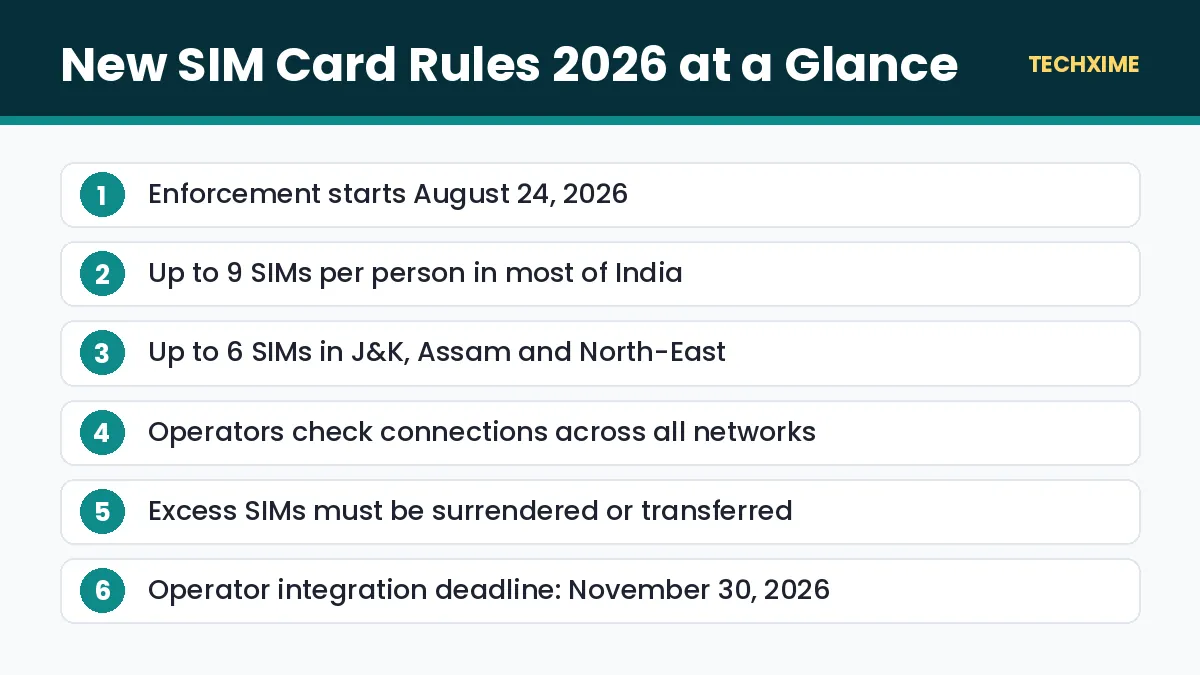
The limit counts all mobile connections in your name across all operators, including prepaid, postpaid and data-only SIMs.
Why the Government Introduced These Changes
SIM cards obtained with fake or borrowed identities are widely used for phishing calls, digital arrest scams, OTP fraud and fake social media accounts. When fraudsters can buy dozens of SIMs using someone else’s documents, it becomes very difficult for police to trace them.
The Digital Intelligence Platform run by DoT combines subscriber data from all operators. This allows the system to spot suspicious patterns, such as one person holding many connections in different circles. The new SIM card rules use this platform to block excess connections at the point of sale.
Who Is Affected by the New SIM Card Rules?
Most people with one or two SIMs will not notice any change. You are affected if:
- You hold many SIMs for work, business, or IoT devices in your personal name.
- You bought SIMs years ago and forgot to disconnect them.
- A shop, agent or stranger misused your Aadhaar or ID to issue SIMs.
- You manage connections for family members using your own documents.
If any of these apply to you, check your connections today using Sanchar Saathi.
Penalties Under the Telecommunications Act, 2023
The Telecommunications Act, 2023 sets penalties for holding connections above the notified limit. A first violation can attract a fine of up to ₹50,000, and repeat violations can attract a fine of up to ₹2 lakh. Obtaining a SIM using fraud, impersonation or fake documents is treated far more seriously, with possible imprisonment and heavy fines.
This is why it is important to disconnect SIMs you do not need and report any number you do not recognise.
How to Check SIMs in Your Name: 7 Easy Steps
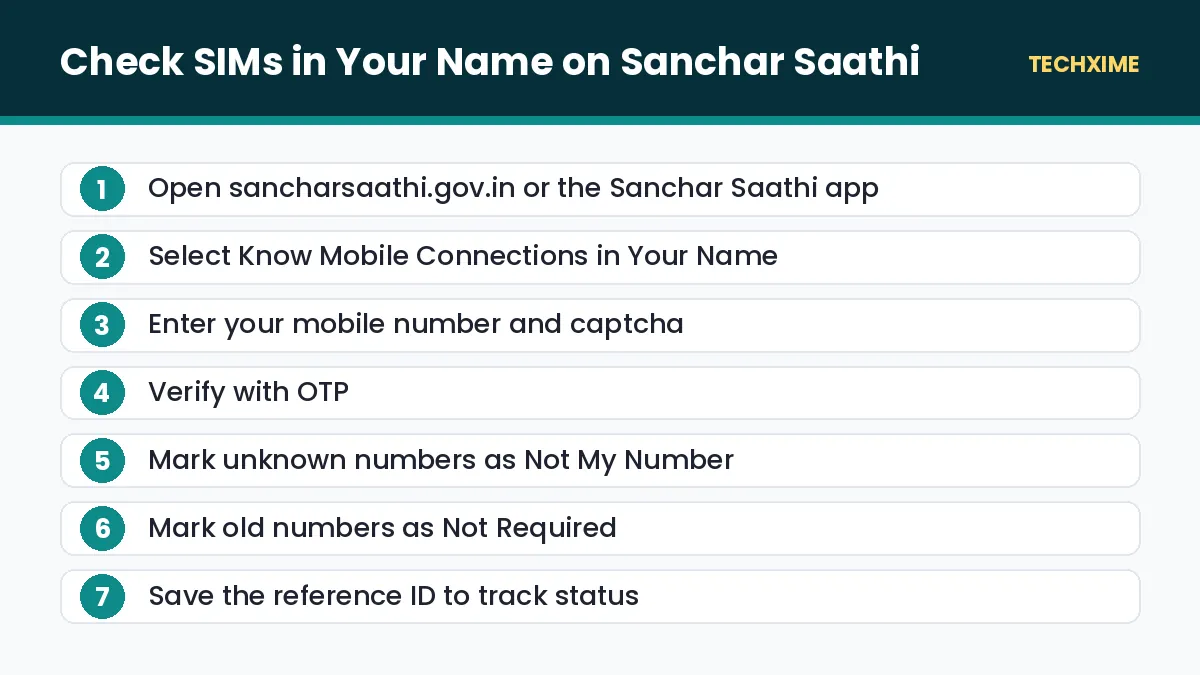
The easiest way to follow the new SIM card rules is to know exactly how many numbers are linked to you. The government’s Sanchar Saathi portal has a free service called “Know Mobile Connections in Your Name”. It shows all numbers linked to your identity and lets you report ones you do not recognise. Here is how to use it.
Step 1: Open the Sanchar Saathi Portal
Visit the official Sanchar Saathi website or install the Sanchar Saathi app from the Google Play Store or Apple App Store.
Step 2: Go to Citizen Centric Services
On the home page, open “Citizen Centric Services” and select Know Mobile Connections in Your Name.
Step 3: Enter Your Mobile Number
Type any one of your active mobile numbers and fill in the captcha.
Step 4: Verify With OTP
Enter the one-time password sent to your phone. This confirms that you own the number.
Step 5: View All Connections
You will see a list of mobile numbers registered with the same identity documents. Review the list carefully.
Step 6: Mark Each Number
For each number, choose one option:
- Not My Number: For numbers you never took. The operator will investigate and disconnect them.
- Not Required: For old numbers you no longer use. The request goes to the operator for disconnection.
- Required: For numbers you still use. No action is needed.
Step 7: Save the Reference ID
After you submit, you will receive a reference ID. Use it to track the status of your request on the same portal.
What to Do If You Have More Than 9 SIMs
If you already hold more connections than allowed under the new SIM card rules, you have three options:
- Surrender: Disconnect the numbers you do not need through Sanchar Saathi or your operator’s store.
- Transfer: Move a connection to a family member or employee who will use it. The new holder must complete their own KYC.
- Business connections: Move work SIMs to a company account through the operator’s business or bulk KYC process.
Do this before operators complete their integration with the central platform by November 30, 2026.
Other Useful Sanchar Saathi Services
Sanchar Saathi is much more than a SIM checker. It also helps you:
- Block a lost or stolen phone using its IMEI number through the CEIR service. Follow our step-by-step guide to block a lost mobile phone.
- Report fraud calls and messages through the Chakshu facility.
- Verify a phone’s IMEI before buying a used device.
- Report incoming international calls that show an Indian number.
Tips to Protect Your Identity From SIM Fraud
The new SIM card rules make fraud harder, but your own habits still matter.
- Never share photocopies of your Aadhaar without writing the purpose and date on them.
- Use the masked Aadhaar option when an ID is required. You can download Aadhaar card in masked format from UIDAI.
- Lock your Aadhaar biometrics from the mAadhaar or Aadhaar app when not needed.
- Never give OTPs to anyone who calls claiming to be from a telecom operator or bank.
- Check Sanchar Saathi every few months, especially after buying a new SIM.
- Disconnect old numbers before throwing away or giving away a SIM.
How the New SIM Card Rules Affect Buying a New SIM
Buying a new SIM will feel slightly different under the new SIM card rules. Here is what to expect at a retailer or operator store.
- Identity verification: You will complete KYC using Aadhaar-based e-KYC or other valid documents, as before.
- Live photo: The operator captures your live photograph, which can be matched against existing records.
- Connection count check: The operator’s system checks your total connections across all networks.
- Declaration: You may be asked to confirm or declare your existing numbers.
- Approval or refusal: If you are below the limit, the SIM is issued. If you are at the limit, the operator must refuse and tell you why.
If your application is refused even though you believe you hold fewer SIMs, check Sanchar Saathi. Old numbers you forgot about, or numbers issued fraudulently in your name, may be counted.
New SIM Card Rules for Families and Businesses
Many families register all SIMs in the name of one person, usually a parent. This can quickly add up if you include data SIMs for tablets, dongles and smartwatches. Under the new SIM card rules, it is better for each adult to hold connections in their own name. Transfer a connection by visiting the operator store with both people present and completing the change of ownership process.
Businesses should avoid issuing employee SIMs in a founder’s or manager’s personal name. Operators offer corporate connections with bulk KYC, which do not count toward an individual’s personal limit in the same way. Moving work numbers to a company account also makes it easier to manage and recover numbers when employees leave.
What Happens to Existing Extra SIMs?
The new SIM card rules focus first on stopping new connections beyond the limit. However, operators are also expected to identify people who already hold excess connections. If you are one of them, you may receive a message from your operator asking you to choose which numbers to keep. Respond quickly to avoid numbers being disconnected without your choice. Numbers linked to your bank, UPI and Aadhaar should be the ones you keep.
Myths and Facts About the New SIM Card Rules
| Myth | Fact |
|---|---|
| Everyone must re-verify their SIMs | Most users need not do anything if they are within the limit |
| The limit has been reduced | The limit remains nine (six in some regions); enforcement is stricter |
| Old SIMs will be cut without notice | Operators generally inform subscribers before action |
| Sanchar Saathi is a paid service | It is a free government service |
New SIM Card Rules and eSIM
eSIM connections also count toward your limit under the new SIM card rules. An eSIM is simply a digital SIM, but it is still a mobile connection issued in your name after KYC. If you use an eSIM on a smartwatch that shares your phone number, it usually does not create a new number. However, a separate eSIM number on a tablet or second phone does count.
Checklist: What You Should Do This Week
Use this quick checklist to make sure you comply with the new SIM card rules:
- Check all numbers in your name on Sanchar Saathi.
- Report any number you do not recognise as “Not My Number”.
- Disconnect old numbers you no longer use.
- Move work SIMs to your company’s corporate account.
- Transfer family members’ SIMs into their own names.
- Update your bank, UPI and Aadhaar with the number you plan to keep.
- Recheck Sanchar Saathi after a few weeks to confirm disconnections.
Taking these steps now saves you from trouble later, whether you are buying a new SIM, porting a number or applying for a loan that needs mobile verification.
Porting and the New SIM Card Rules
Mobile number portability (MNP) is not affected by the limit in a way that increases your connections. When you port a number from one operator to another, the number stays the same and simply moves to a new network. It does not count as an extra connection. However, the new operator will still complete KYC and may check your total connections during the process under the new SIM card rules.
Tips for Senior Citizens and Students
Older people and students are common targets of SIM fraud because their documents are often shared with shops and agents. Help family members check Sanchar Saathi, explain OTP scams, and make sure only needed numbers stay active in their names. Students living in hostels should keep only one or two numbers and avoid lending their ID to friends for new connections.
Key Terms Explained
– DoT: Department of Telecommunications, which sets SIM rules. – Digital Intelligence Platform: DoT’s system for sharing subscriber data across operators. – KYC: Know Your Customer, the identity verification process for a SIM. – Sanchar Saathi: The government’s citizen portal for telecom safety services. – CEIR: Central Equipment Identity Register, used to block lost phones.
Frequently Asked Questions
What are the new SIM card rules in 2026?
From August 24, 2026, operators must check your total mobile connections across all networks before issuing a new SIM. If you have already reached the limit of nine (six in some regions), you cannot get another connection.
How many SIM cards can one person have in India?
Under the new SIM card rules, one person can hold up to nine mobile connections in most of India, and up to six in Jammu and Kashmir, Assam and the North-Eastern states.
How do I check how many SIMs are in my name?
Visit sancharsaathi.gov.in, open “Know Mobile Connections in Your Name”, enter your number and OTP, and view the list.
What happens if someone got a SIM using my ID?
Mark the number as “Not My Number” on Sanchar Saathi. The operator will verify and disconnect it. You can also file a complaint with local police or at the national cybercrime portal.
Is there a fine for having more than nine SIMs?
Yes. Under the Telecommunications Act, 2023, the fine can go up to ₹50,000 for a first violation and up to ₹2 lakh for repeat violations.
Do data-only and IoT SIMs count toward the limit?
Connections issued in your personal name count toward your total. Business devices should ideally be registered under a company account.
Conclusion
The new SIM card rules do not reduce the limit for ordinary users, but they finally enforce it across all operators. Most people only need to spend five minutes on Sanchar Saathi to check their connections, disconnect old numbers and report anything suspicious. Doing this today protects you from fraud and keeps you on the right side of the law.