
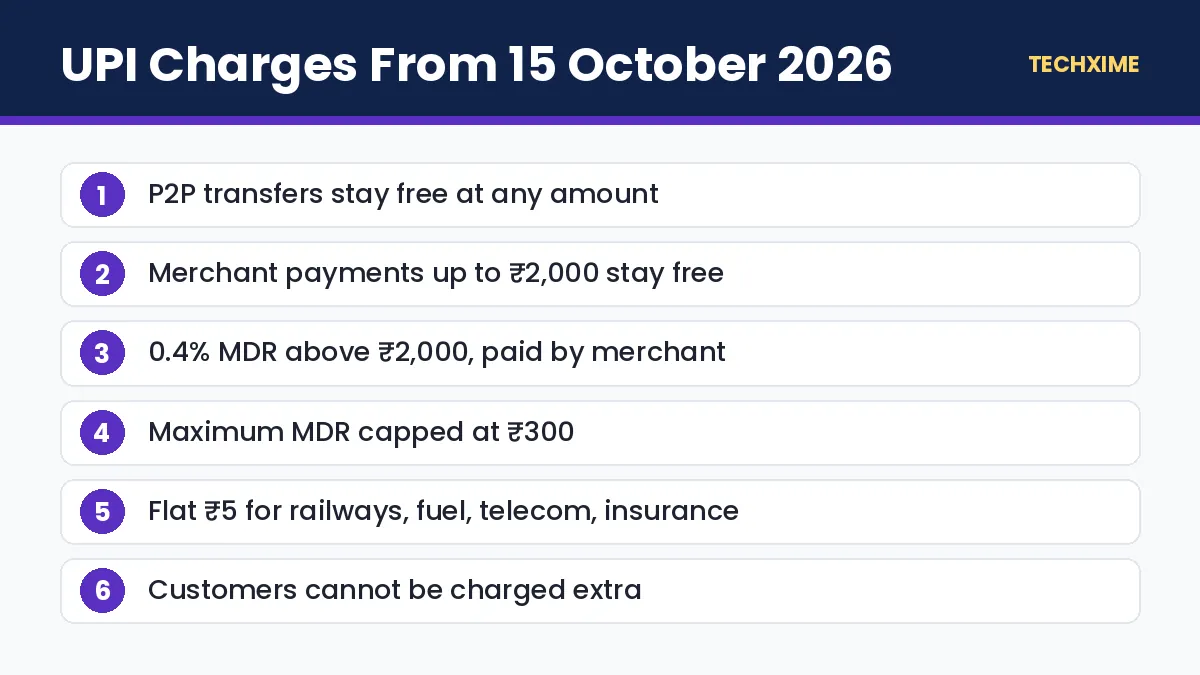
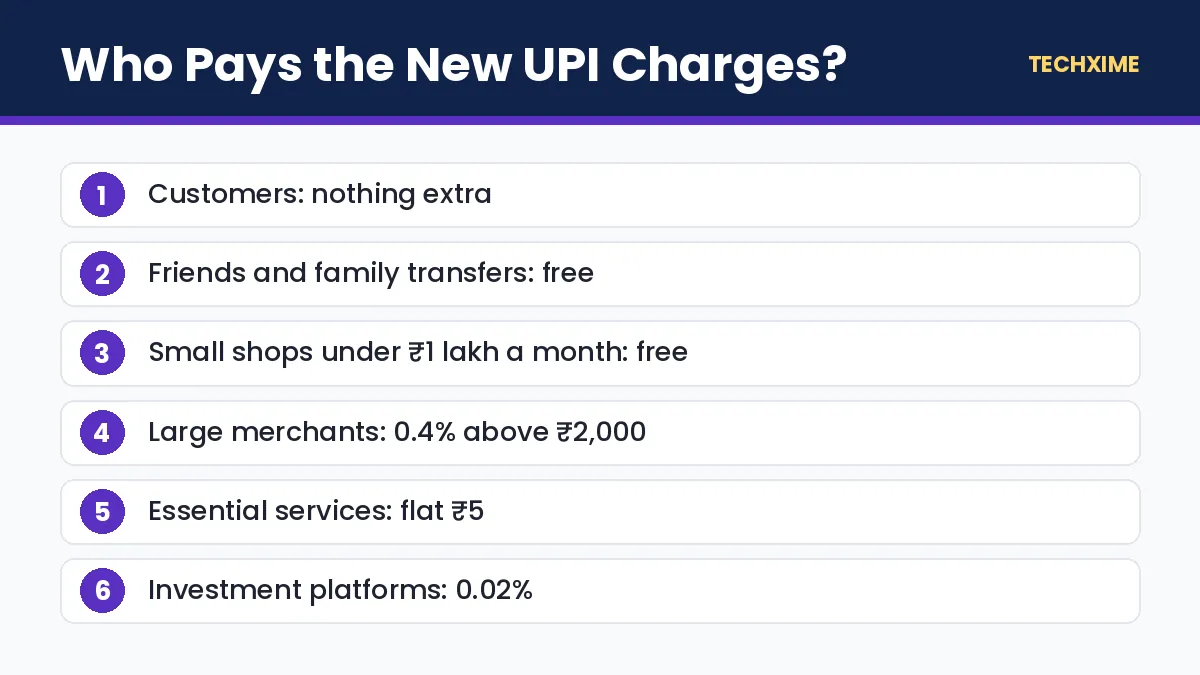
New UPI charges come into effect from 15 October 2026. Under the framework announced by the National Payments Corporation of India (NPCI) on 15 September 2026, merchants will pay a Merchant Discount Rate (MDR) of 0.4% on UPI payments above ₹2,000. The good news for ordinary users is simple: customers do not pay anything extra, and person-to-person transfers remain completely free.
Since UPI became India’s favourite way to pay, it has been free for both customers and most merchants. That is why the news of UPI charges has created confusion on WhatsApp and social media. In this guide, we explain the new UPI charges in plain language: who pays, how much, which payments are exempt, what changes for shopkeepers, and nine things every UPI user should know before 15 October.
Table of Contents
What Are the New UPI Charges?
The new UPI charges are a Merchant Discount Rate, or MDR. MDR is a small fee that a merchant pays to banks and payment companies for accepting digital payments. Card payments have always carried MDR. UPI was kept at zero MDR for years to promote digital payments.
From 15 October 2026, NPCI’s revised framework introduces MDR on selected person-to-merchant (P2M) UPI payments. Here is the core structure:
| Payment Type | UPI Charges (MDR) | Who Pays |
|---|---|---|
| Person-to-person (P2P) transfers | 0% at any amount | Nobody |
| P2M payments up to ₹2,000 | 0% | Nobody |
| P2M payments above ₹2,000 | 0.4% | Merchant |
| Payments of ₹75,000 and above | 0.4%, capped at ₹300 | Merchant |
| Railways, fuel, telecom, insurance | Flat ₹5 per transaction above ₹2,000 | Merchant |
| Capital market payments | 0.02%, capped at ₹300 | Merchant |
Do Customers Have to Pay UPI Charges?
No. This is the most important point. NPCI’s FAQs clearly state that the MDR is borne by the merchant. Merchants are not allowed to pass the fee on to customers. You will continue to pay only the listed price of the product or service.
If a shop asks you to pay “2% extra for UPI”, that is not part of the official UPI charges framework. You can politely refuse, pay by another method, or report it to your UPI app’s customer support.
Which UPI Payments Stay Free?
Most everyday payments remain free even after the new UPI charges begin.
Person-to-Person Transfers
Sending money to family, friends, a landlord or anyone’s personal UPI ID is free at any amount. Splitting bills, sending pocket money and paying your house help are not affected.
Small Merchant Payments
Paying ₹2,000 or less at a merchant, such as a tea shop, grocery store, auto driver or online order, stays free for the merchant as well.
Small Merchants Under ₹1 Lakh a Month
Small merchants who receive up to ₹1 lakh a month through UPI QR codes under the P2PM category continue to enjoy zero MDR, even on individual payments above ₹2,000.
Credit-Linked UPI Payments
Payments made with RuPay credit cards linked to UPI follow their own card-based pricing and are not part of this MDR framework.
UPI Lite
Small UPI Lite payments are well below the ₹2,000 threshold. If you use UPI Lite for daily small payments, nothing changes for you.
How Much Will Merchants Pay? Examples
Here are simple examples to understand the new UPI charges for a regular merchant that does not fall under the small-merchant exemption.
| Payment Amount | MDR Rate | Merchant Pays |
|---|---|---|
| ₹500 | 0% | ₹0 |
| ₹2,000 | 0% | ₹0 |
| ₹5,000 | 0.4% | ₹20 |
| ₹25,000 | 0.4% | ₹100 |
| ₹75,000 | 0.4%, capped | ₹300 |
| ₹2,00,000 | Capped | ₹300 |
For a petrol pump, railway booking or insurance premium above ₹2,000, the merchant pays a flat ₹5 instead of 0.4%.
Why Is NPCI Introducing UPI Charges?
UPI processes billions of transactions every month. Banks and payment apps spend heavily on servers, fraud prevention, customer support and uptime. Under zero MDR, they earned almost nothing directly from merchant payments.
According to the published framework, the money from MDR will fund cybersecurity, system uptime and digital payment infrastructure across issuing and acquiring banks. Supporters say this makes UPI more sustainable. Critics, especially trader associations, argue it may push some merchants back to cash for bigger payments.
Is There a Legal Challenge?
Yes. A Public Interest Litigation has been filed in the Supreme Court questioning how the fee was introduced. The petition argues that the 0.4% rate, the ₹300 cap and the ₹5 flat fee appear in NPCI and Finance Ministry communications rather than in the Gazette notification itself.
As of now, there is no stay, and the government has not announced any rollback. The UPI charges are scheduled to begin on 15 October 2026. We will update this article if the court passes an order.
9 Things Every UPI User Must Know
Here are nine practical points to remember about the new UPI charges.
1. You Will Not See a Fee in Your UPI App
Your PhonePe, Google Pay, Paytm or BHIM app will not show any extra fee on merchant payments. The MDR is deducted on the merchant’s side during settlement.
2. P2P Transfers Are Always Free
Transfers between individuals are completely outside the new UPI charges, whatever the amount.
3. The ₹2,000 Limit Is Per Transaction
The threshold applies to each payment, not your daily or monthly total. Ten payments of ₹1,500 each attract no MDR.
4. Splitting Payments to Avoid MDR Is the Merchant’s Choice
Some merchants may ask you to pay a large bill in two parts. This is allowed only if they choose it; it is not required by the rules.
5. Surcharges Are Not Allowed
Merchants cannot add a “UPI fee” to your bill. The listed price is the price.
6. Daily Limits Have Not Changed
The new UPI charges do not change your daily UPI limit. Most banks continue to allow up to ₹1 lakh per day for regular payments, with higher limits for certain categories such as tax, insurance and hospital payments.
7. Utility and Fuel Payments Are Treated Differently
Railways, fuel, telecom and insurance payments above ₹2,000 attract only a flat ₹5 for the merchant, which keeps essential services affordable.
8. Watch Out for Scam Messages
Fraudsters are already sending fake SMS messages saying “Pay ₹99 UPI service charge to keep your account active.” There is no such fee for customers. Never enter your UPI PIN to receive money.
9. Your Credit Score Is Not Affected
The new UPI charges have nothing to do with credit. However, if you use UPI credit lines or Pay Later, timely repayment matters. Learn how to check CIBIL score for free.
What Changes for Shopkeepers and Small Businesses?
If you run a shop or business, here is how the new UPI charges may affect you:
- Small shops with UPI receipts under ₹1 lakh a month: No change; MDR stays zero.
- Larger stores and online sellers: 0.4% MDR on payments above ₹2,000, deducted at settlement.
- Fuel stations, insurers and telecom recharge partners: Flat ₹5 per qualifying transaction.
- Settlement statements: You will see MDR deductions in the statements from your bank or payment aggregator.
To prepare, check your monthly UPI collections, ask your bank or payment partner how your account is categorised, and factor the cost into your pricing instead of charging customers separately.
UPI Charges vs Card Charges
Even after the change, UPI remains cheaper for most merchants than card payments.
| Payment Method | Typical Merchant Cost |
|---|---|
| UPI up to ₹2,000 | Free |
| UPI above ₹2,000 | 0.4%, capped at ₹300 |
| Debit cards | Varies; RuPay debit cards have zero MDR |
| Credit cards | Typically 1.5% to 2% or more |
| Cash | No MDR, but handling and security costs |
This is why most experts believe UPI will continue to dominate digital payments in India even with the new UPI charges.
Timeline: How UPI Pricing Has Changed
– 2016: UPI launched by NPCI with very low charges. – January 2020: The government made MDR zero on UPI and RuPay debit cards to boost digital payments. – 2023: Interchange fees were introduced on certain prepaid wallet (PPI) payments above ₹2,000, paid by merchants. – September 2025: NPCI raised limits for certain high-value merchant categories such as insurance, capital markets and travel. – 14 September 2026: A Gazette notification removed the zero-charge protection for UPI merchant payments above ₹2,000. – 15 September 2026: NPCI published the MDR framework and FAQs. – 15 October 2026: New UPI charges take effect.
Who Is Affected the Most?
| User Type | Impact of UPI Charges |
|---|---|
| Regular customers | No impact; no fee |
| Students and families sending money | No impact; P2P is free |
| Small shops and street vendors | Mostly no impact if under ₹1 lakh a month |
| Large retailers and e-commerce sellers | 0.4% on payments above ₹2,000 |
| Fuel stations, insurers, telecom | Flat ₹5 per payment above ₹2,000 |
| Stock brokers and investment platforms | 0.02%, capped at ₹300 |
How Merchants Can Reduce the Impact
Merchants who fall under the new UPI charges can take a few practical steps:
- Check the category: Make sure your business is correctly classified, especially if you qualify as a small merchant or an essential service.
- Negotiate with your payment partner: Payment aggregators may offer bundled pricing for high-volume merchants.
- Encourage UPI Lite and small payments: Everyday low-value sales remain free.
- Track MDR in accounts: Record MDR as a business expense. It may be deductible as a business cost; ask your accountant.
- Avoid surcharges: Charging customers extra can lead to complaints and action from your bank or payment partner.
How to Stay Safe While Using UPI
– Never share your UPI PIN, OTP or screen with anyone. – Remember that you never need a PIN to receive money. – Verify the merchant name before paying by QR code. – Turn on app lock and biometric security in your UPI apps. – If your phone is lost, block your SIM and UPI immediately. Follow our guide to block lost mobile phone. – Report fraud quickly on the national cybercrime helpline 1930.
Quick Summary: UPI Charges
– New UPI charges start on 15 October 2026. – Merchants pay 0.4% MDR on P2M payments above ₹2,000, capped at ₹300. – Customers do not pay UPI charges, and merchants cannot add surcharges. – P2P transfers and payments up to ₹2,000 remain free. – Small merchants with up to ₹1 lakh monthly UPI receipts stay exempt.
Key Terms Explained
– MDR: Merchant Discount Rate, a fee merchants pay for accepting digital payments. – P2P: Person-to-person transfers between individuals. – P2M: Person-to-merchant payments to shops and businesses. – P2PM: Small merchants who use personal-style UPI QR codes with limited monthly receipts. – NPCI: National Payments Corporation of India, which runs UPI. – Settlement: The process by which a merchant receives the money after deductions.
Expert Tips
– Keep using UPI for everyday payments; nothing changes for customers. – For large purchases, compare UPI with RuPay debit card or net banking only if a merchant offers a discount. – Merchants should check their category with their bank before 15 October. – Follow official updates on the NPCI website rather than forwarded messages.
Frequently Asked Questions
What are the new UPI charges from 15 October 2026?
Merchants pay a 0.4% MDR on UPI payments above ₹2,000, capped at ₹300 per transaction. Railways, fuel, telecom and insurance attract a flat ₹5, and capital market payments attract 0.02%.
Do customers pay UPI charges?
No. The MDR is paid by the merchant, and merchants are not allowed to pass it on to customers.
Are UPI transfers to friends and family free?
Yes. Person-to-person transfers remain free at any amount.
Will UPI payments up to ₹2,000 have charges?
No. Merchant payments up to ₹2,000 have zero MDR.
Are small shopkeepers affected?
Small merchants receiving up to ₹1 lakh a month via UPI QR codes remain exempt from the new UPI charges.
Can a shop charge me extra for paying by UPI?
No. Surcharging customers is not allowed under the framework.
Conclusion
The new UPI charges starting 15 October 2026 are a merchant-side fee, not a customer fee. You can keep sending money to friends and paying at shops exactly as before, and payments up to ₹2,000 remain free for everyone. Larger merchants will pay 0.4% on bigger UPI payments, capped at ₹300, while essential services get a flat ₹5 rate. Stay alert to scam messages, never pay any so-called “UPI fee” as a customer, and keep following official NPCI updates as the legal challenge progresses.